
The Bear Child
[BACK\One of my favorite life experiences has to be Unemployed And Slightly High In The University Library (very good experience recommend). Inevitably I end up deciding to look for an interesting book and am usually disappointed at the sight of thick tomes that I would place in the category "Someone's Thesis". As a sidenote, I've been really into looking at old photos of my hometown (posted on a Facebook group) and matching the old buildings to the gentrified cafes that stand in their place. So of course I will present an article (and there will be more) taken out of a 1954 absolute unit of a book with a green cover.

In the "Chronicles of West Thessaly" (which I can't find info on, at least on the internet), says the article, there is a report of a "bear child" found near Kalampaka in 1891. The child was captured by an officer while drinking "cheese-milk" or whey, the liquid that remains after milk curdles to become cheese (ew). The author was, of course, intrigued, and decided to look into this story more.
Of course the author starts with a too-long for what it is anecdote where he travelled to another village and on the way there met an old lady from old Koutsoufliani. Pause. I was a little weirded out by the "old" part of this village's name and I was hoping to find a ghost village story there. And as it seems, in 1898, residents of Koutsoufliani (the one that is now called "old") lit the village on fire and evacuated it after Greek forces failed to free their village from the Turks. I have not been really able to determine whether the "old" village is still in use or exists or what it is. Anyways, back to the author - while chatting about bears (as you do, in 1950s Epirus), the old lady mentions that yes, bears did come into their village, but not as much as the old times. Years ago, she says, the bears had stolen a baby and raised him as their own.

There are three stories in the article. The first one takes place around 1870 when a woman goes to work in the field with her child of 3 years and 4 months. She puts the baby down to sleep because she couldn't leave him alone at home considering she planned to be in the field all day; a few hours later, when she goes to check on him, the child is gone. The woman screams and freaks out and the neighbors first and then the whole village comes to help her and they all look and nothing is found. And then, 2-3 years later, hunters in the forest start reporting something walking with a bear that doesn't quite look like a cub but occasionally walks in its hind legs. The child starts consistently appearing in certain locations and women who visit the village are reportedly warned to not leave their kids outside, lest they be stolen by the bears and raised as one of their own. And this is where this story ends.
The second one comes from Estia Magazine of 1891, reporting on a "teenage" wild child that has been captured, is completely wild, walks on all fours, eats nuts and roots and can't speak a word. Apparently the kid gets tied with rope and transported to Trikala. Then, the officer that captured him names him "Skiron" after the infamous evil Corinthian thief, son of Pelopas, who used to prey on people passing through a rocky isolated road to then capture and torture them. I don't know WHAT this kid to justify them fucking him over like damn he can't even talk.
Acropolis Newspaper of October 1891, however, reports a different story. The headline is (rough translation) "A child of the forests - Cave-dweller from Pindos". Here the officer who captures the child while he drinks cheese-milk, first spots him from afar, running on his hind legs towards the sheep pen, but not quite looking like a human. He pulls out his gun to shoot at the strange creature and the shepherds yell "No, no, it's... human!". And that mental image scares the shit out of me.

The child here is 8 years old, of Vlachian descent, and born to parents who couldn't raise their kids and just.. gave them away? And this one somehow ran away and lives in the forest for 4 years now, eating roots and nuts and not speaking or knowing his own name. The author here gets super pissed at how unbelievable that story is, whose most glaring plot hole is of course, the fact that the child at the point when he was abducted, would have surely learnt the language and his name, and those things aren't forgotten easily. I argue that the bear part might be more of an issue and also I am not very sure that 3 year olds are particularly fluent? Alas. He also decides to throw in that he also saw reporting on the village of Soupi, which was completely swallowed by the ground due to earthquakes in 1953, and in its place, appeared a lake full of crabs. This, he says, is outrageous, since it was only most of the houses that got completely destroyed. Journalism is in shambles.
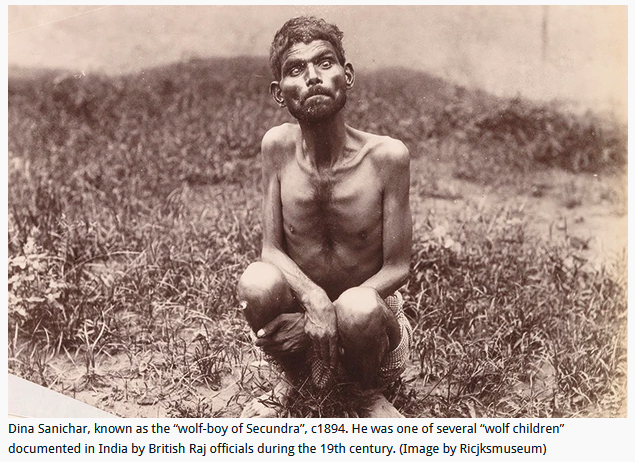
After all the typical for an Epirus villager anecdotes, Mr. Author gives us the conclusion to his research. There was, indeed, a "Wild Man of Pindos" (although he doesn't tell us how he found that), who was indeed 17-18 (like in Estia's reporting) in 1891 Koutsoufliani. He did, actually, appear and act as an animal, and he was in fact the same child who disappeared in the 1870s. He was also known as "BearJohn" (word to word translation that I find super funny) from Old Koutsoufliani. And as if it couldn't get more disappointing, Bearjohn, named Skiron by the man who found him, couldn't handle the new lifestyle and died 2-3 months later "of a broken heart" in Trikala. The end.
First three photos from old Koutsoufliani (presumably). Last photo the kid that actually got raised by animals and was the inspiration behind Mowgli. He is also offhandedly mentioned in the article I found.
[BACK\